Governance documents, read clause by clause
A Governance Glider reads a law, a policy, or a charter one clause at a time. It codes who each clause empowers, burdens, protects, or leaves out, and it quotes the words behind every reading. It can compare frameworks side by side, or check your own documents against the rules you answer to.
Two ways to use it
Compare frameworks
For policy groups, regulators, and civil-society groups. Several laws or frameworks are coded on the same 47 dimensions, so they can be read side by side and clause by clause.
Check your own documents
For general counsel, board secretaries, compliance leads, and nonprofit boards. Each of your published charters, codes, and policies is set beside the rule or guidance line it answers to, row by row.
Who it is for
General counsel
Charters, codes, and policies can fall behind exchange and SEC rules. A checklist shows where, row by row, so counsel's time goes to the rows that need it.
Board and corporate secretaries
Show the board how each document answers its rule, and which rows still need a decision.
Compliance leads
Find where two of your own documents word the same thing differently: a defined term, a dollar limit, or who approves.
Nonprofit boards and executive directors
Form 990 Part VI asks about conflict of interest, whistleblower, and document retention policies. The answers should match what the organization has published.
University policy offices
Check whether an AI policy says who acts, and how a student can contest a decision.
School districts
Get feedback on a draft AI policy before it goes to the school board.
Regulators and policy groups
Compare national laws clause by clause, and see where each one hands its power to a later decree or standard.
Civil-society groups
See whether a protection a law promises reaches anyone, and where the chain breaks.
One clause, start to finish
What a reader sees
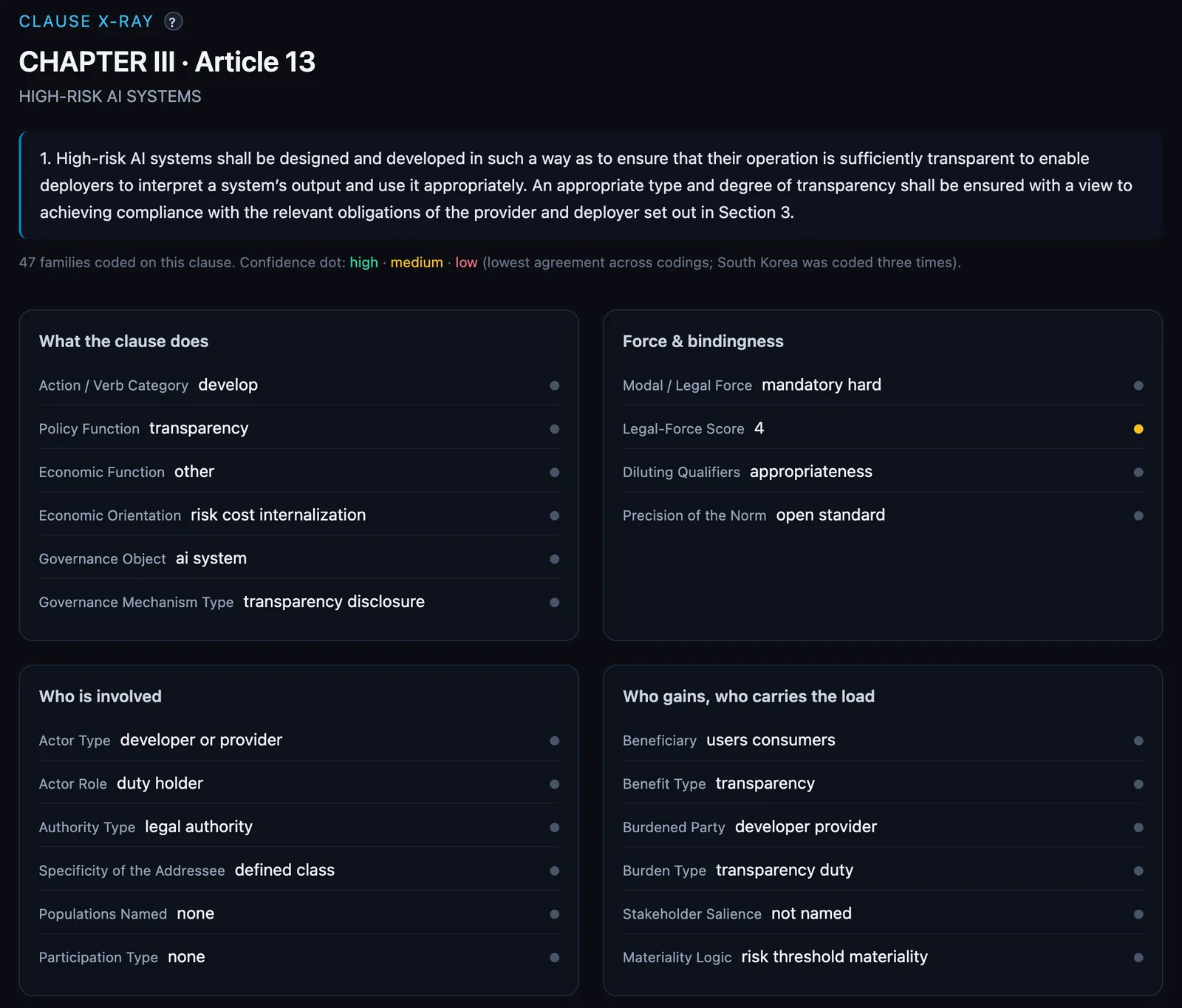
This is Article 13(1) of the EU AI Act, on transparency for high-risk AI systems. The clause sits at the top. Below it are its codes, grouped by what they describe: what the clause does, how binding it is, who is involved, and who gains and who carries the load.
The same page lists the quoted words each code rests on. A reader who disagrees with a code can check it against the text.
Side by side
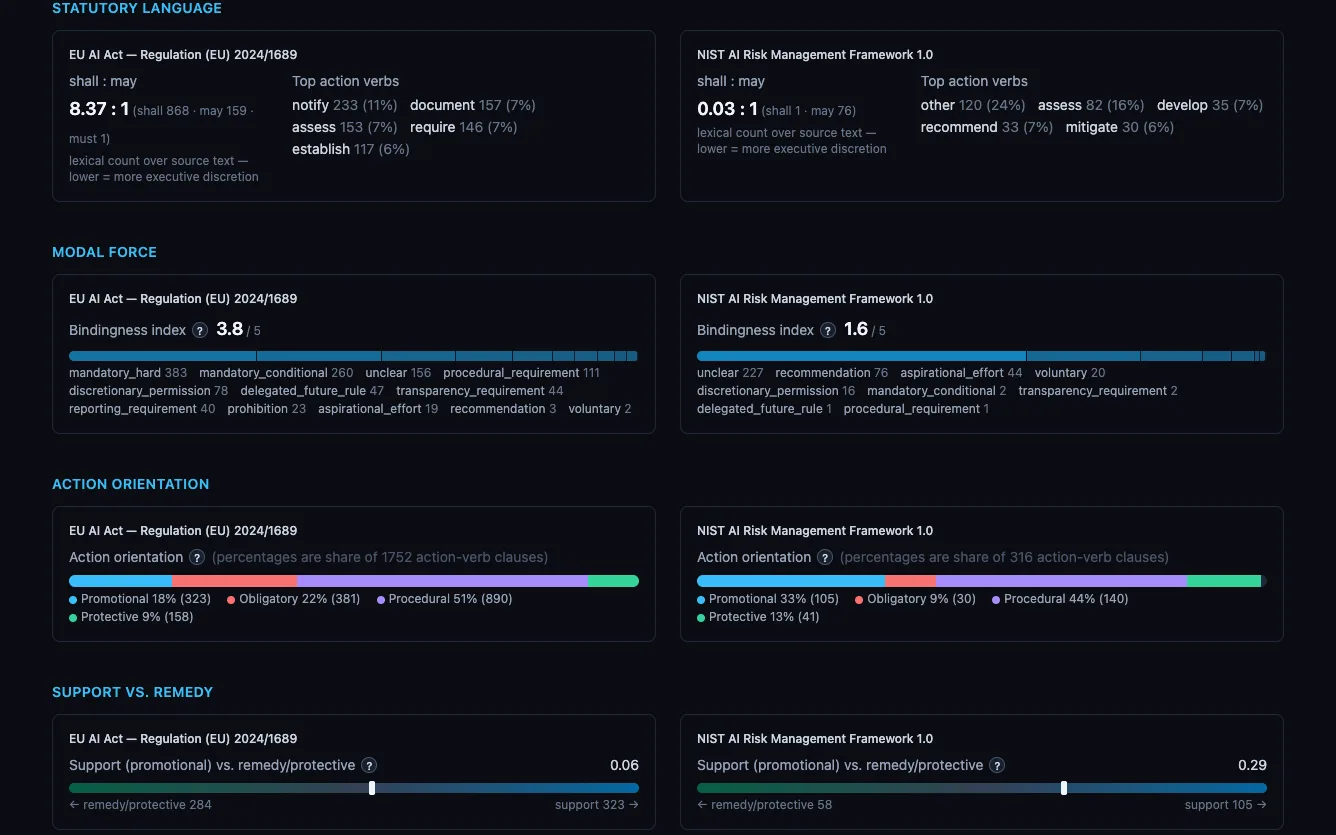
Two to four documents can share one screen, coded the same way. Here the EU AI Act sits beside the NIST AI Risk Management Framework: how often each says shall rather than may, how binding its language is, and how many of its clauses promote, oblige, set procedure, or protect.
What it does
Clause by clause
Built.Each document is split into single clauses, and each clause is coded on 47 dimensions: what it does, how binding it is, who it involves, who gains, who carries the load, and where it sends its power. Every code carries the quoted words it rests on.
Where the power goes
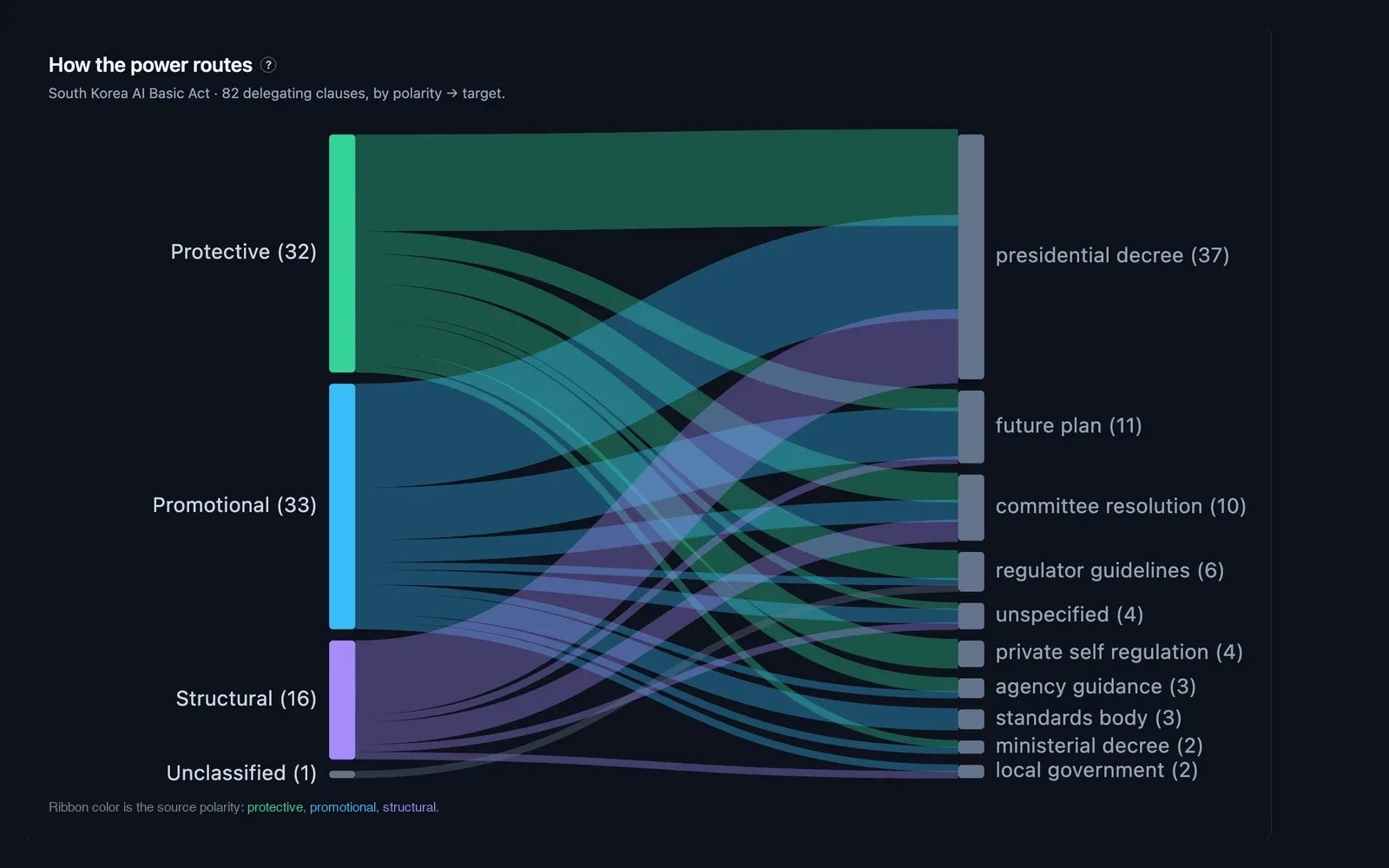
Built.A view of the clauses that leave their substance to a later decree, standard, or committee, and who ends up holding that power.
Whether a protection reaches anyone
Built.For each protection a document promises, how far the chain runs toward a person who could use it, and where it breaks.
A report on one document
Built.A one-page report on a single document, with every claim citing its clause. The coding can also be exported as a spreadsheet, as data, or as a memo.
Bring your own document
Built.Upload a policy or a law of your own. An estimate of the processing cost is shown before coding begins.
Your documents against your rules
Working demo.Each charter, code, and policy is set beside the rule or guidance line it answers to, and marked addressed, partly addressed, or not found. Only laws and listing rules can make an item required. Guidance lines are never marked required.
A suggested edit for counsel
Working demo.Where a document only partly answers its rule, the row states the concern and drafts a small edit for counsel to review. The edits can be opened in Word with tracked changes.
Dates
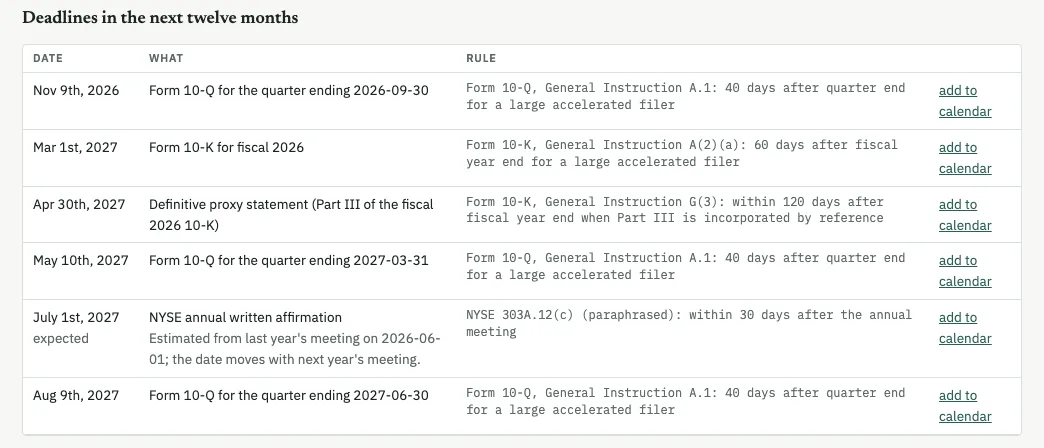
Working demo.Filing deadlines worked out from the organization's own facts, such as its fiscal year and filer status, and the reviews its own documents promise. Each date shows the rule it comes from.
Where two documents disagree
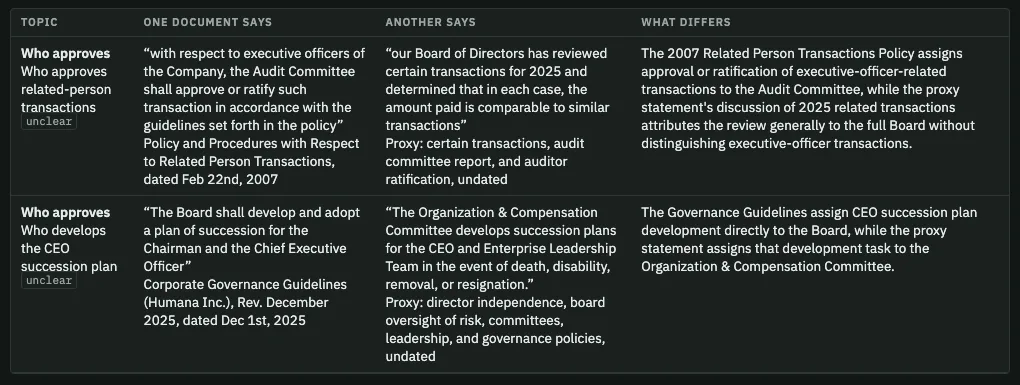
Working demo.Places where two of an organization's own documents answer the same question differently: a defined term, a dollar limit, or who approves. Both quotes are checked word for word against their documents.
Form 990
Working demo.For nonprofits that file Form 990, the Part VI answers read against the policies the organization has published.
Five questions about your AI policy
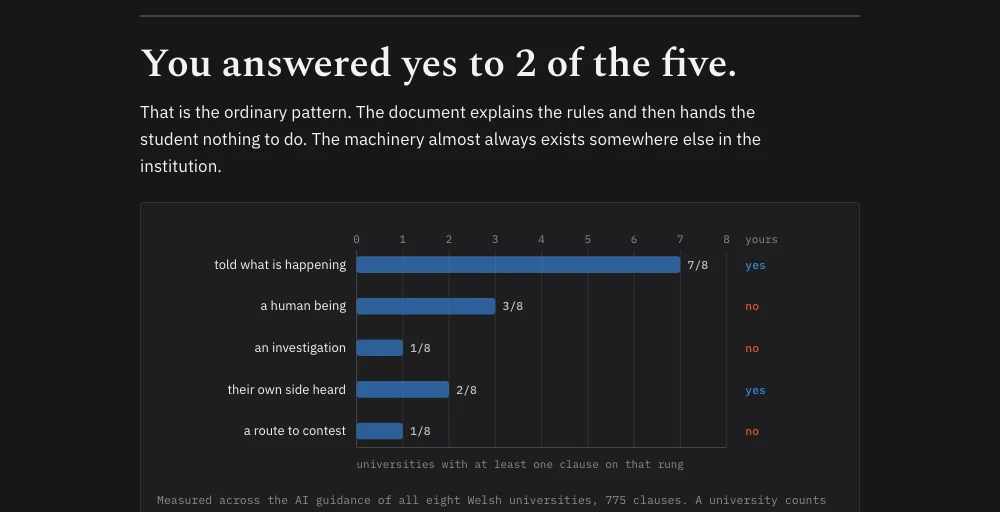
Built.A two-minute self-check for a university's AI policy, scored against the AI guidance of eight Welsh universities.
A record of the board's decisions
Prototype.The board's decision on each row, saved beside the row it answers.
The checklist, row by row
The checklist demo runs on the published documents of nine organizations: eight listed companies and one nonprofit. Every checklist is built only from documents an organization has already published or chooses to send.
One row
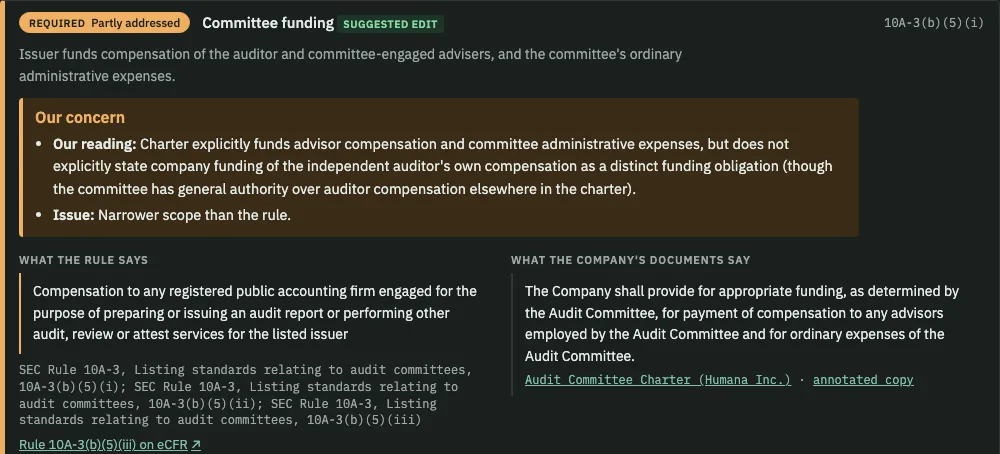
The rule is on the left and the company's own words are on the right, each with a link to its source. The box above them states the concern. In this row, the reading is that the charter funds the committee's advisers and running costs and does not state funding for the outside auditor's own pay.
The status chip says whether the item is required, and whether the documents address it in full, in part, or not found.
Where two documents disagree
In this example, a related-person policy and a proxy statement name different bodies for the same approval. The table quotes both, names both sources, and says what differs. Whether that matters is a question for counsel.
Dates
Deadlines worked out from the company's fiscal year, filer status, and last annual meeting. An estimated date is marked as expected, with the reason it may move.
How it works
A first look
Send us one policy or charter, or name your organization if its documents are public, and we will show you what a Governance Glider finds in it.
A pilot on your documents
Your full set, read against the rules that apply to you, with the checklist on a private page.
Built for your rules
The rule set is chosen for each organization: listing rules, SEC rules, Form 990, sector guidance, or your own internal standards.
Your material, your say
Built only from documents you choose or have already published. The checklist stays on a private page for the people you choose.
What it is, and what it is not
A Governance Glider is a reading aid for the people who own these documents and for their counsel. It does not give legal advice.
The codes and findings are suggestions from a language model. Each one is tied to the words it rests on and marked for review by a person. A reading can miss a gap, and it can report one that is not there, so a person reads each finding before anyone acts on it.
A checklist reads the documents and rules as they stood on the day it ran. When a rule or a document changes, it can be run again.
Where it came from
The first Governance Glider was built for a policy group comparing national AI laws. It has coded 23 governance documents, from the EU AI Act and South Korea's AI Basic Act to climate disclosure rules: 8,619 clauses and 344,010 codes. In South Korea's act it found 82 clauses that hand power to a later instrument, most often a presidential decree. Read about it on our Work page
Try it on your own documents
We are looking for a few organizations to try a Governance Glider on their own documents and tell us what works and what does not.
Write to us