The methods behind every Glider
Glider Innovations is built on its own methods, developed over more than 25 years by our founder, James Intriligator, and his collaborators, and published in journals, conference proceedings, and the press.
Transversal Design
Real problems live across many dimensions at once: the people involved, the institution around them, the materials, the money, the rules, the history, and how everyone feels about it. Most methods pick one of those and work inside it. Transversal Design maps the dimensions a problem really has, moves across them on purpose, and looks hard at what shows up between them. The output is something you can build: a mechanism, a program, or a system.
The word comes from transversal theory, which James developed with the playwright and theorist Bryan Reynolds from 1998.
-
Gliding
In 2023 James wrote in The Conversation that the best way to work with a language model is to glide, not search: steer a long conversation across a problem instead of firing single questions at it. What a model says should be treated as "imaginative conjectures that require further verification, analysis and filtering by you, the human pilot." The same division of labor runs through every Glider. The system does the reading at scale, and people decide where to land.
-
Polymorphic Combinatorial Frameworks
A formal framework for designing AI agents that adjust their core traits (their skills, personalities, approaches, resources, and knowledge) to fit a changing situation, tested in more than 1.25 million simulations. By David Pearl, Matthew Murphy, and James Intriligator, 2025.
-
Persona Multiplication
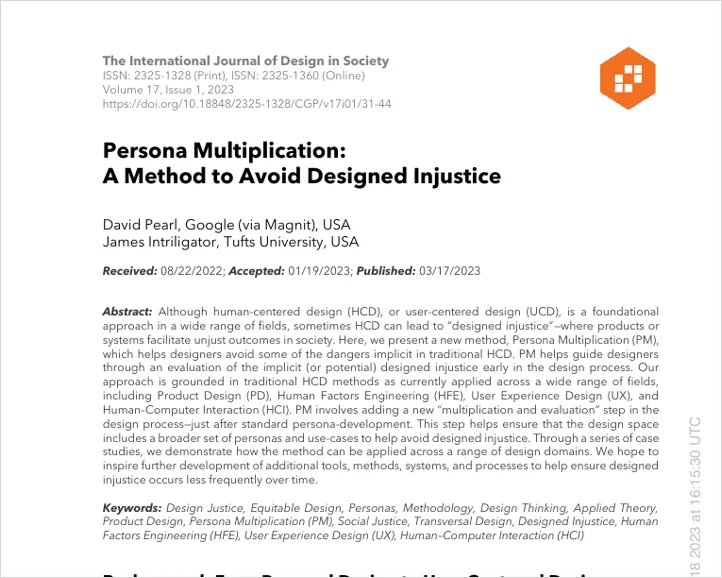
Developed with David Pearl. Human-centered design usually works from a handful of typical users, and the people it leaves out can end up harmed by the result. Persona Multiplication multiplies the usual personas across a much wider range of people and uses, and tests the design against each. Published in 2023 in The International Journal of Design in Society.
-
Multidimensional Task Analysis
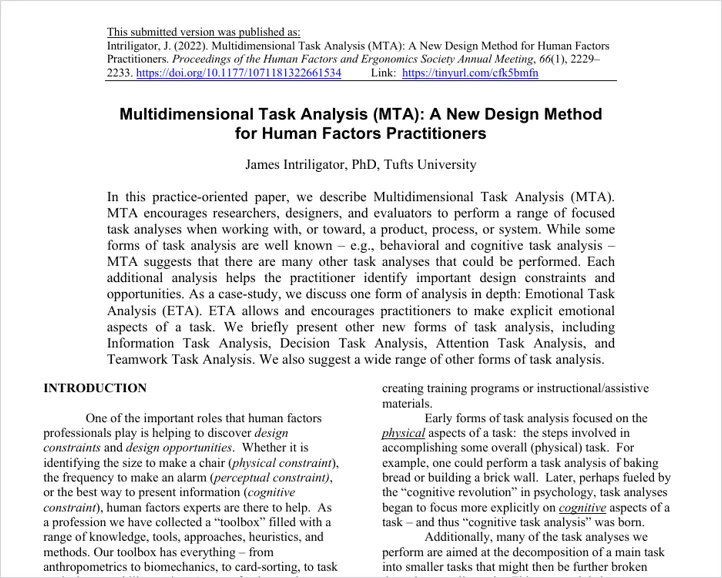
Human factors has long analyzed tasks by what people do physically and mentally. Multidimensional Task Analysis adds analyses that usually go undone, of emotion, information, decisions, attention, and teamwork, because each one finds design constraints and opportunities the others miss. Published in 2022 in the Proceedings of the Human Factors and Ergonomics Society.
These two papers list Dr. Intriligator's Tufts University affiliation, given for identification. The work on this site is independent of Tufts University: it is not the opinion of, and is not sponsored or endorsed by, Tufts.
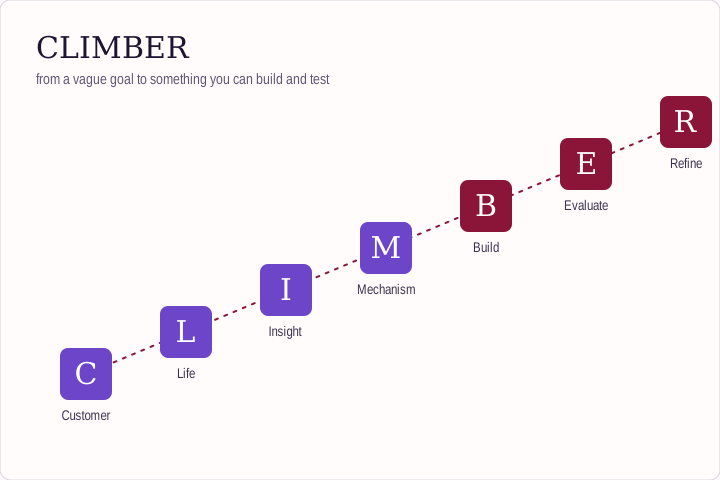
CLIMBER
The design process we teach and use: Customer, Life, Insight, Mechanism, Build, Evaluate, Refine. It moves a team from a vague opportunity to a mechanism someone can build and test.